Tilapia fingerlings and tilapia breeding colonies for sale
The lowest prices - period!Live and healthy arrival guaranteed.
Lifetime technical support on every purchase.
No-fault 30 day replacement plans are available.
Lowest cost shipping - no big surprises at checkout!
Tilapia fingerlings for sale
Buying tilapia fingerlings from the largest tilapia hatchery in America has its perks. Lakeway Tilapia has the lowest prices on tilapia fingerlings. We do not charge more than necessary for shipping or display a lower price on our tilapia fingerlings only to tack on bogus shipping charges or packaging fees in the shopping cart. We guarantee the live and healthy arrival of your tilapia fingerlings and won't make you jump through hoops to get them replaced if it's ever needed. In fact, we are so confident in the health of our fish that we offer a no-fault 30 day replacement plan as an option with of our Food Grade Tilapia® fingerlings. To top it all off, we give every customer free technical support for life.
Our tilapia fingerlings are raised in our own hatcheries and shipped nationwide. We do not source our tilapia from other aquaculture facilities. We do not operate hatcheries in Florida or in the Great Lakes region or any other area that has been associated with freshwater fish diseases caused by Viral hemorrhagic septicemia, toxic algae or dangerous swamp bacteria stirred up by hurricane flooding. We are on the approved senders list in heavily restricted states such as Hawaii and licensed to ship into regulated states such as Illinois. We offer alternative tilapia species for states that require them and have successfully delivered tilapia to customers located in areas previously thought impossible.
We raise our own tilapia fingerlings
When you buy tilapia fingerlings from Lakeway Tilapia, you are getting fish that were actually raised in our hatcheries. We do not drop ship for other companies and we don't have other companies drop ship for us. The same cannot be said for most of the tilapia resellers on the Internet.
We only sell viable tilapia farming species
There are nearly 100 species of tilapia in the world. Only two species are farmed. This is because most tilapia do not grow very fast or very big. For decades people have experimented by mixing species into hybrids like the so-called "Red Nile" or "White Nile" or the exotic sounding "Hawaiian Gold" but these are all slow-growing hybrids that produce unreliable results. Pure Strain Blue and Pure Strain Nile on the other hand are extremely fast growing tilapia. In fact, they are tied as the second-fastest growing freshwater fish on earth.
The Pearl Nile Tilapia: There is a rare Pearl Nile that lives in one lake in Egypt and grows to a large size. Some tilapia sellers display a picture of a man holding up a 20 year old Pearl Nile inferring that it is one of their customers holding up one of their White Nile tilapia. White Niles (or Red Niles for that matter) are a made up name for a slower-growing hybrid mix of species that does not exist in the taxonomy of aquatic life.
There are three grades of tilapia fingerlings
A mistake often made by aquaponics growers, who tend see plants as copies of each other, is believing that all tilapia of a particular species are essentially clones of one another. But nothing could be further from the truth. Every tilapia, even within the same species has unique traits that set it apart as an individual. One characteristic that is of particular importance to both aquaponics and aquaculture is what is known as the rate of growth. As each tilapia is hatched into this world, a unique rate of growth has already been coded into its DNA. In every brood, there are tilapia that have the potential to grow to 20 ounces in six months as well as tilapia that will barely get to three ounces in the same amount of time.
Debunking the male tilapia myth: There exists a myth that male tilapia grow faster and to a larger size. This is untrue. Fast growth rate is a trait like any other. The trait for fast growth rate is more prevalent in males, but not all males possess the trait. Conversely, there are fast-growing females. Less than half of the offspring hatched from a single brood will have a trait for fast growth and roughly 30% of those will be female.
Problems can arise when tilapia of different growth rates are kept together. The larger tilapia will always dominate the smaller ones for control over food. This causes the average and small sized tilapia to adapt by suppressing their appetites which further inhibits their growth and leads to stunting, a condition which makes them permanently small. We solve these problems by sorting our tilapia fingerlings into three grades: Food Grade™, Aquaponics Grade™, and Pond Grade™ when they are very young.
Grading is nothing new, in fact most fish farming involves some sort of periodic grading. What is new is the technique of grading tilapia fingerlings before they weigh 30 grams. This process is what put Lakeway Tilapia on the map years ago and what continues to set us apart today. The process to grade tilapia at one gram takes the knowledge of a marine biologist and the ability to invent new methods and equipment. A single 30 gram tilapia juvenile costs the same to ship as 50 one-gram tilapia fingerlings, making it cost prohibitive in the past to ship graded fish. By inventing a new way to identify the different grades at only 30 days old, we are able to ship graded tilapia at a cost that anyone can afford.
Our process in a nutshell is easy to understand. We keep all of the offspring from a single brood together for a month. Then, at exactly 30 days, we use our equipment to identify tilapia that exhibit the abilities and characteristics of the most developed specimens. For example, the ability to swim backwards is only possible at a certain stage of growth and because functioning fins are a requirement to be a fingerling, the first fish to gain the ability to swim backwards are the furthest along in the development process. These are the Food Grade. At 40 days, we grade the remaining brood, but this time we cull out the fish that have not developed in sync with the rest. These are the smallest and therefore the Pond Grade. Everything else is Aquaponics Grade.
When you buy tilapia fingerlings from our hatchery, you can choose from these three different rates of growth, or grades, to suit your needs. If you are interested in finding out more about sorting tilapia by their rate of growth and how growth rates affect the efficiency of your tilapia farm, visit our Tilapia Fingerling Grading page on our main website, Lakeway Tilapia. And of course, all of our tilapia fingerlings have been inspected. They are disease and hormone free and they have not been genetically modified in any way.
Very Important: Some states, like New Mexico for example, actually require that tilapia be treated with sex-reversal hormones or be rendered chemically sterile, unable to reproduce. This is intended to keep them from breeding in the event that they are released into the wild. The warning labels on these chemicals warn that they are dangerous for human contact. We do not consider tilapia treated with these chemicals safe for human consumption.
We do not treat or alter our tilapia fingerlings in any way, they are as nature intended.
Pure strain Blue tilapia
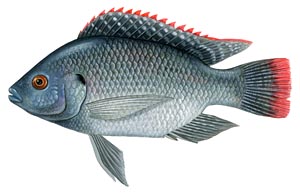
Maximum temperature: 106º F
Minimum temperature: 47º F
Minimum oxygen level: 7ppm
Known in some parts of the world as a "St. Peters Fish", after the bible story of Jesus sending Apostle Peter to look into the mouth of the first fish he caught for a coin to pay the temple tax, our Blue tilapia fingerlings are identical to the ones swimming in the Sea Of Galilee over two thousand years ago. They can grow to over nine pounds and 24 inches in length. In the wild, Blue tilapia live comfortably in water ranging from 60º F to 86º F but they can tolerate water as warm as 106º F and as cold as 47º F for short periods of time. It is very important to note that every other species of tilapia, including hybrids, will stop converting food into growth below 70º F and will die below 60º F. Blue tilapia are by far the most temperature forgiving of all the tilapia species, making them perfect for the climate in north America.
Most of the tilapia that is served in restaurants and sold in stores in the United States is Blue tilapia. Unlike other species of tilapia, Blue tilapia do not have a so-called "sand vein" to store silt and other unwanted water particles under their skin. This gives them a delicious light flavor that takes on just about any seasonings when prepared.
Food Grade Blue tilapia fingerlings
All of our graded tilapia are between 30 and 40 days old. There will be slight size variations between the fish in your order due to this age difference. Please read the size descriptions carefully so that you know what to expect.
The selections above work well for orders up to 250 Food Grade Blue Tilapia. For larger orders we have money-saving options available by calling us at (865) 262-8289.
If you need more than 250 Food Grade Blue Tilapia, you will save money by allowing us to take your order over the phone. Call (865) 262-8289 for assistance.
Please note that our Food Grade Blue tilapia fingerlings are selected for their fast growth and as a result there will be fewer females. If you are looking for a more even mix of males and females, try our Aquaponics Grade or Un-Graded Blue Tilapia.
Aquaponics Grade Blue tilapia
You will need one tilapia for every 3.74 gallons of water in your aquaponics system. If your system is larger than 1,100 gallons or you need more than 300 Aquaponics Grade Blue, you can save a lot of money by letting us optimize your shipment. Call us at (865) 262-8289 for assistance.
Our Aquaponics Grade blue tilapia have a more staggered growth rate to help maintain nitrifying bacteria in aquaponics systems. They can all be eaten and will eventually reach a harvestable weight. They are also a good mix of males and females for those wanting to try their hand at breeding.
Pond Grade Blue tilapia
If you need more than 500 Pond Grade Blue or your pond is larger than 1/2 acre, let us customize your order to save money and ensure the performance that you are looking for. Call (865) 262-8289.
Pond Grade tilapia are at the other end of the spectrum from their Food Grade siblings. These are the slowest-growing tilapia. They will not grow to a harvestable size in a single season, it will take them much longer. They are however perfect little algae-eaters for any pond owner trying to stay away from dangerous herbicides to control algae blooms. They are also predominantly female, which means that the few males there are will have their work cut out for them reproducing!
Pure strain Nile tilapia
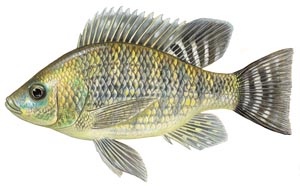
Maximum temperature: 108º F
Minimum temperature: 60º F
Minimum oxygen level: 3ppm

Nile tilapia have been farmed in Egypt for over five thousand years. They have their own hieroglyph and are depicted in the frescos, carvings, and scarabs found in several ancient Egyptian tombs. Nile tilapia fingerlings can grow to be as large as 24 inches. They live naturally in water temperatures ranging from 70 to 91º F, but they can survive in water temperatures as high as 108º F.
Nile tilapia are the most commonly farmed tilapia in the tropical regions of the world and a popular choice with aquaponic farmers in the Caribbean. We do not recommend Nile tilapia for aquaculture or aquaponics north of the gulf coast or the Florida peninsula, due their abysmal cold water tolerance and increased cost to maintain in colder winter climates.
Food Grade Nile tilapia fingerlings
Aquaponics Grade Nile tilapia
Tilapia fry for sale
Save money with un-graded tilapia fry. Since 10 to 12 day old tilapia fry can't be graded for size or rate of growth, we offer them at a price that reflects our time savings. For those of you who want to stagger or delay the introduction of tilapia fingerlings into your ponds, keeping tilapia fry on hand is a great way to ensure that you'll have new tilapia stock ready to go when you are. Tilapia fry will only grow as fast as you feed them and you can actually regulate their development a bit by feeding more or less per day. Just make sure that you always give enough food to allow for some growth, and not completely stop it. If you have questions about raising tilapia fry, please contact us and we'll be happy to teach you everything you need to know.
Pure strain un-graded Blue tilapia fry
Tilapia breeding colonies for sale
Tilapia breeding colonies are the way to go for anyone who wants to raise their tilapia from scratch. We only sell young compatible tilapia that will typically begin to produce fingerlings within a few weeks of their arrival. You can keep breeding colonies in 55 gallon aquariums for several months, if you carefully control their food intake so that they don't outgrow their home. If you're curious about to expect when your tilapia breeding colony arrives, we've made the YouTube video above to show you.
Tilapia do not automatically breed, they must have a genetic pre-disposition to engage in spawning activity. This fact does not seem to deter a handful of people from selling random males and females as tilapia breeding colonies to customers looking to save money. We strongly urge you to read our Tilapia Breeding Guide on our main website at LakewayTilapia.com before you purchase any breeding colony.
Pure strain Blue tilapia breeding colonies
Minimum breeding temp: 68º F
Optimal breeding pH level: 8.0
Blue tilapia breeding colonies consist of six fish: one male and five females. The scientific name for Blue tilapia is Oreochromis aureus. Other names for Blue tilapia are Israeli tilapia and St. Peters Fish. They are native to the Sea of Galilee (Lake Tiberias), the rivers of the Jordan Valley, the Lower Nile River, and the Chad Basin.
If you need more than one pure strain Blue breeding colony, contact us for pricing and to place your order.